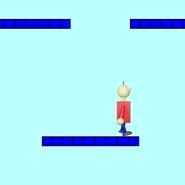
Why does a game with no story, no dialogue, and a stick figure for a protagonist keep making players restart the same three-second stretch of level forty times in a row? Vex 6 answers that by stripping platforming down to pure timing and trap memorization, then betting that the satisfaction of finally nailing a sequence is worth more than the frustration of failing it thirty-nine times first.
| Genre |
Trap-Based Platformer |
| Platform |
Browser |
| Levels |
9 main Acts, 9 Hard Acts, daily bonus stages |
| Core Mechanic |
Wall jumps, double jumps, checkpoint-based trap avoidance |
Nine Acts, Then Nine Harder Ones
Vex 6’s structure is deliberately linear: 9 main Acts that must be cleared in order, no skipping ahead, followed by 9 Hard Act remixes of the same core level ideas turned up in difficulty. Daily bonus stages sit on top of both, giving returning players a reason to check in even after finishing the main Acts once. Nothing about the progression is optional — each Act gates the next, which means a player stuck on Act 4 genuinely cannot experience Act 7 until it’s cleared.
That gating is part of what makes Vex 6 feel harder than its stick-figure aesthetic suggests. There’s no difficulty selector and no way to bypass a level that clicks badly with your particular timing.
Wall Jumps and Double Jumps Change the Grammar Mid-Game
Early Acts test only basic jump timing, but Vex 6 keeps introducing new movement verbs as it goes — wall jumps and double jumps both get added partway through the Act list, and once they appear, earlier obstacle types get recombined using the new move as an implicit requirement. A gap that was unpassable with a single jump in an early Act becomes trivial once double jump is unlocked, but new gaps show up specifically sized to need it, so the difficulty curve never actually flattens.
Checkpoints: The Only Mercy the Game Offers
Green flags mark checkpoints throughout each Act, and touching one saves your progress within that level — there’s no life counter and no permanent penalty for dying, you simply respawn at the last flag touched. That checkpoint design is what keeps Vex 6’s brutal trial-and-error pacing from becoming punishing in the way a limited-lives system would; the cost of failure is a few seconds of replay, not a full level restart.
Fixed checkpoint placement also means memorization pays off precisely — once a player knows which flag sits before a difficult trap sequence, they can drill that one sequence in isolation rather than replaying an entire Act to reach it again.
Spikes, Saw Blades, and Collapsing Platforms
The specific hazards Vex 6 throws at players escalate in a fairly consistent order across the Acts: spikes on floors and walls that kill on the lightest touch, spinning saw blades that function as moving walls requiring exact timing rather than just avoidance, and collapsing platforms that look stable but give way the instant weight lands on them. Later Acts and especially the Hard Acts combine these types in sequence rather than presenting them one at a time, which is where most of the game’s reputation for difficulty actually comes from.
What Separates a Good Run From a Restart
- Reading collapsing platforms before landing — a half-second hesitation is usually enough to notice one before committing weight to it.
- Using wall jumps to reset momentum near saw blades, rather than trying to out-run their swing arc.
- Treating checkpoints as practice markers — deliberately dying just past a flag to drill the next trap in isolation, rather than only progressing forward.
Hard Acts in Vex 6: The Same Ideas, No Slack Left
The 9 Hard Acts don’t introduce new hazard types so much as remove the margin for error from the ones already established — gaps between saw blades shrink, checkpoint spacing widens, and platform collapse timing tightens. Players who found the main 9 Acts manageable frequently describe the Hard Acts as a completely different difficulty tier, since the same movement toolkit now has almost no room for the small timing slips the main Acts tolerated.
Daily Bonus Stages: A Reason to Come Back
Alongside the 9 Acts and 9 Hard Acts, Vex 6 rotates in daily bonus stages, giving players who’ve already cleared the main level list a reason to open the game again rather than shelving it after the credits roll. These stages don’t change the fundamental toolkit — spikes, saws, and collapsing platforms still make up the bulk of the challenge — but their rotation means the specific trap layout a player memorizes today won’t be the one waiting tomorrow, which keeps the checkpoint-memorization strategy from turning the game fully solved.
Questions About Acts and Checkpoints
- Can I skip a level in Vex 6 if I’m stuck? No — Acts must be cleared in order, and there’s no difficulty setting or level-select bypass for a stage giving you trouble.
- What’s the difference between the main Acts and Hard Acts? Hard Acts reuse the core obstacle types from the main 9 Acts but tighten timing windows and platform spacing, rather than introducing entirely new hazards.
- Do checkpoints reset if I close the game? Checkpoints only persist within a single attempt at an Act — touching a green flag saves your position for that run, letting you respawn there instead of restarting the whole Act after a death.
Vex 6 never dresses up what it is: a stick figure, a set of traps, and a checkpoint system generous enough to make forty attempts at the same three seconds feel like progress instead of punishment. By the time a player reaches the Hard Acts, that stick figure has usually earned every wall jump and double jump the game handed it along the way.