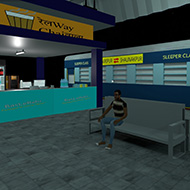
What happens when a shift at Fakripur station suddenly goes quiet? That question is exactly what pulls players deeper into Railway Chai Wala, because the silence never means nothing is happening — it usually means something is about to.
What Happens When Fakripur Station Grows Quiet in Railway Chai Wala
A busy platform is loud in a predictable way: trains, chatter, orders stacking up. When that noise drops off without warning, players quickly learn to treat it as a signal rather than a break. Ramu’s shop sits at the center of all of it, and the absence of a crowd is often more unsettling than the crowd itself.
New players tend to read quiet stretches as downtime to relax. Experienced players read them as setup.
That shift in interpretation — from “empty platform” to “something’s coming” — is one of the clearest markers of how far along you are in understanding the game’s rhythm.
Reading Passengers Before They Reach the Counter
Passengers approach Ramu’s stall with visible cues before they even place an order — posture, pace, which direction they came from. None of it is spelled out directly, which means players end up building their own mental shorthand for who’s “normal” and who isn’t.
This is where community vocabulary starts showing up in discussions, with players describing certain passengers as feeling “off” long before anything overtly strange happens on screen.
Story-focused players tend to slow down and actually watch passengers approach, while players optimizing for a clean shift barely register them until the order hits the counter.
The Order Queue and Why It Matters More Than It Looks
Order sequencing — the choice of which pending request to fulfill first — turns out to matter more than raw speed. Prioritizing the wrong order during a rush doesn’t just slow Ramu down; it can leave a passenger waiting long enough to trigger a different, quieter kind of interaction than a straightforward sale.
Vada Pav, Chai, and the Small Details Players Notice
Vada pav takes longer than chai or a bottle of Kokila Kola, and that gap in preparation time is deliberate. It forces a choice: serve the quick order first and let the vada pav customer wait, or commit to the slower item and risk the queue behind it.
Small sensory details reinforce the setting too — the specific sound of chai being poured, the clatter of the frying station, the announcements layered under the platform noise. These are the kinds of details players bring up when they talk about what actually sold them on the atmosphere.
None of this is explained through tutorial text. You just start noticing it.
Where Railway Chai Wala Starts Feeling Wrong
There’s a stretch, once the story starts to surface, where the ordinary rules of running Ramu’s stall no longer fully apply. Orders start to feel less like transactions and more like tests, and the station itself stops being neutral background.
Reaching this point is the moment most players cite when describing why the tone shifted for them personally — it’s rarely one single scare, more a gradual realization that the framing of the whole game has changed.
Some players find this transition too abrupt given how grounded the opening shifts are. Others consider that contrast the entire point.
Sound Design and the Platform After Dark
Fakripur station sounds different once the lighting shifts. The ambient train noise thins out, footsteps carry further, and Ramu’s own small sounds — pouring, frying, the clink of a Kokila Kola bottle — become noticeably more prominent in the mix.
That contrast between a loud, busy daytime station and a sparse, exposed nighttime one is one of the more effective and commonly praised design choices in the whole experience.
What New Players Consistently Misjudge
The most common mistake is treating every shift like the first one. Difficulty here isn’t just about order volume — it’s about how much attention the surrounding details demand as the story develops.
Players who blaze through dialogue with passengers tend to miss context that makes later moments land properly, since much of what Railway Chai Wala is doing lives in small exchanges rather than big set pieces.
Balancing Speed and Story Progression
Rushing every shift for a clean serve isn’t wrong, but it changes what kind of playthrough you end up having. Slowing down costs you efficiency at the counter and gives you back nearly everything the game’s quieter storytelling depends on.
Long-Tail Questions Players Actually Ask
- Is Railway Chai Wala scarier than it looks from screenshots? Not in the jump-scare sense — the tension comes from passengers, pacing, and the slow shift in tone at Fakripur station rather than sudden shocks.
- Does serving the wrong order have consequences? It affects how the shift and certain passengers respond, and mishandling a queue during a key moment can change what you notice about the station’s secrets.
- Can you replay Railway Chai Wala to catch missed details? Yes, and many players do exactly that, since several passenger behaviors and station cues only make sense once you already know what’s coming.
Ramu never gets an easy shift in Railway Chai Wala, and that’s precisely why the station keeps pulling players back — between the Kokila Kola bottles, the vada pav queue, and the moments Fakripur stops feeling like just another stop on the line, there’s more going on here than a first glance at the counter suggests.