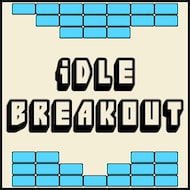
Idle Breakout looks like a Breakout clone with the paddle removed, but it plays like a spreadsheet you’re slowly convincing to fight for you. There’s no reflexes involved once the first few balls are bouncing — the entire game becomes a question of which ball type earns its upgrade cost back the fastest, and when to burn it all down for a permanent boost.
| Genre |
Idle / Incremental Breakout |
| Platform |
Browser |
| Core Loop |
Buy balls, upgrade damage and speed, break bricks automatically |
| Reset Mechanic |
Prestige for permanent power |
From Basic Ball to a Screen Full of Chaos
Every run of Idle Breakout starts with the Basic Ball, cheap and reliable, chipping away at a wall of bricks with no real strategy required yet. It doesn’t stay useful for long — Basic Balls become obsolete almost as soon as you can afford a Plasma Ball, which hits far more bricks per pass and carries the early-to-mid game almost single-handedly. Sniper Balls solve a different problem entirely, targeting the specific bricks that survive longest instead of spraying damage evenly, which matters once a wall starts developing stubborn high-health stragglers in the corners.
By the time Scatter and Cannonballs enter the mix, the screen has usually stopped looking like a puzzle and started looking like a slow-motion demolition — Cannonballs in particular hit harder and faster than anything before them, and are usually the ball type still active when a wall of bricks stands no real chance of surviving the wave.
Upgrades: Speed, Damage, and Where the Money Actually Goes
Idle Breakout’s upgrade screen rewards a fairly specific order: damage and speed first, since they compound directly into every ball you already own, followed by multi-hit and bonus effects like poison or an explosion radius once the basics stop being the bottleneck. Speed has a hard ceiling — 40 by default, extendable to 60 once the relevant skill points are spent in the skills tab — so late-game optimization shifts away from speed entirely and toward maximizing damage per hit instead.
Damage upgrades matter most whenever a specific ball type is falling behind the wall’s total health pool, since a slow ball with high damage still clears bricks a fast, weak ball can’t touch.
Multi-Hit, Poison, and Explosion Upgrades
Once base damage and speed stop being the bottleneck, the bonus-effect upgrades start doing the heavy lifting. Multi-hit lets a single ball damage more than one brick per contact instead of bouncing off after the first, poison applies damage over time to whatever it touches, and an explosion radius turns a single impact into splash damage across neighboring bricks. None of these replace raw damage — they multiply how efficiently that damage gets spread across a wall that’s several bricks deep.
Prestige in Idle Breakout: When Starting Over Is the Correct Move
Prestige resets your balls and your money, but not your skill points or the skills already purchased with them — which is what keeps it from feeling like punishment. The community’s general rule is to prestige once a wall is taking noticeably longer to clear than it used to, rather than on any fixed timer, since the permanent bonus damage and speed from prestiging is what makes the next run’s early bricks disappear almost instantly.
New players commonly delay their first prestige far longer than they should, assuming the reset erases everything meaningful — in practice the skills carried over usually make the very next run outpace the one just abandoned within a few minutes.
Long-time players tend to disagree on exactly how aggressively to prestige, since resetting too early can feel like it wastes a wall that was almost cleared anyway, while resetting too late leaves permanent bonus points sitting unclaimed. That tension between claiming the reset bonus and finishing the current wall is one of the few genuinely debated calls in an otherwise idle game, and it also answers the three things most new players search for when they first hit a wall that stops clearing: when to prestige, which ball actually breaks the most bricks per cost, and why their speed upgrades stopped doing anything past a certain point — the answer to that last one is almost always the 40-speed cap, not a bug.
Idle Breakout’s whole appeal comes from that loop repeating cleaner each time: Basic Ball gives way to Plasma, Plasma gives way to Sniper and Scatter, and every prestige makes the next wall of bricks fall just a little faster than the last one did.