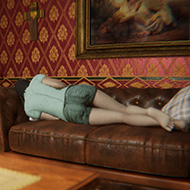
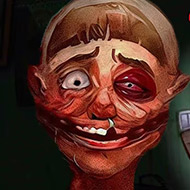
The mother waiting in your own kitchen in That’s Not My Mom! might already be a mimic before you’ve noticed anything wrong, and that’s the entire premise the game is built on.
| Genre |
Anomaly-finding psychological horror |
| Platform |
PC |
| Mode |
Single-player, first-person |
| Core Focus |
Spot-the-difference observation |
| Setting |
A single family home, revisited repeatedly |
Memorizing the House Before the First Anomaly in That’s Not My Mom!
The opening visit doesn’t throw anything wrong at you. It’s a baseline. You walk the same handful of rooms, taking in furniture placement, wall decorations, cushions, and small household clutter, because every later visit measures itself against what you noticed here. Skip this step and every following day becomes guesswork instead of observation.
- Furniture position and orientation in the living room and hallway
- Small decorative items — plants, paintings, cushions
- Where the mother figure is usually positioned when you arrive home
- Ambient sound levels during a normal, uneventful return
New players tend to treat this first pass casually, assuming they’ll catch anomalies through instinct alone. That rarely holds up once the game starts introducing changes small enough to miss without a genuine mental checklist.
Reading Behavior Instead of Just Appearance
Not every anomaly is visual. The mimic can behave differently — staying seated when she normally moves toward the door, following the boy through rooms she never used to enter, or appearing in a spot she has no reason to occupy. This behavioral layer is what separates That’s Not My Mom! from a simple hidden-object exercise, and it’s also where most misidentifications happen.
When the Mimic Changes Position, Room, or Form
By the time the outbreak has spread further into the story, the mimic starts shifting into more openly deformed states rather than just subtly wrong ones. These later encounters demand faster recognition, since the game gives you far less time to compare against memory once the anomaly stops being subtle.
The City-Wide Outbreak Behind the Front Door
The house isn’t the whole story. As the boy keeps returning from school, dialogue and environmental hints make clear that whatever is affecting the mother figure is spreading through the wider city, and that widening context is what turns a single strange household into something closer to a citywide anomaly outbreak.
Players who enjoy connecting small environmental clues into a larger narrative tend to get more out of this framing than players purely chasing the next scare.
What New Players Get Wrong on the Early Days
The most common early mistake is rushing straight to the mother figure’s usual spot without checking the rest of the house first. Anomalies aren’t guaranteed to appear near her — they show up anywhere the baseline established a “normal” state, including empty rooms that seem irrelevant.
A second mistake is reacting to every hunch immediately instead of confirming an anomaly before acting on it, which can trigger encounters prematurely.
Choosing to Hide, Run, or Follow Protocol
- Recognition-only moments where identifying the anomaly is enough
- Moments that force immediate movement, either hiding or fleeing the room
- Encounters where following an established protocol correctly is the only way through
Sound Design and the Quiet Between Anomalies
Long stretches of silence do a lot of the heavy lifting here. Dim lighting and understated ambient sound effects make even an ordinary knock at the door feel loaded with dread, and the game leans on that quiet far more than on constant scares.
Community Shorthand From the Anomaly-Spotting Threads
Players discussing the game online have started calling a correctly identified change a “clean spot,” while a missed anomaly that only becomes obvious in hindsight gets called getting “walked past.” Both terms show up constantly in comment sections and video breakdowns.
Where That’s Not My Mom! Draws Mixed Reactions
Reception has been genuinely split. Some players find the day-to-day structure repetitive once the initial dread of the concept wears off, and that criticism shows up often enough in reviews to be worth acknowledging rather than glossing over.
- How many days does That’s Not My Mom! last? The structure stretches well beyond a dozen repeated visits home before the narrative resolves, with the anomaly outbreak escalating steadily rather than all at once.
- Is That’s Not My Mom! similar to Twisted Gallery or Exit 8? The developers have acknowledged both as direct influences on the loop-based, anomaly-spotting core, though the domestic framing of a possibly-replaced mother gives it a more personal tone than a sterile hallway setting would.
- What happens if you approach the mimic in That’s Not My Mom!? Depending on the specific encounter, approaching can trigger a chase, force a hiding decision, or require a precise protocol response, and getting it wrong typically ends the current visit early.
Whether it’s a plant moved two inches to the left or the mother figure sitting exactly where she shouldn’t be, That’s Not My Mom! keeps its horror rooted in the unbearable ordinariness of a house that almost, but not quite, looks like home.