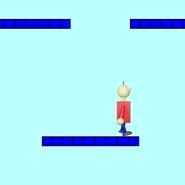
In Dreadhead Parkour you start each level with nothing but momentum and a clear run ahead, which matters the instant the first row of spikes appears and there’s no time left to plan a different route.
Movement Options in Dreadhead Parkour
You control Dreadhead, a stylish dreadlocked runner, using a small set of moves: running, sliding, vaulting, and climbing, each suited to a different type of obstacle. Sliding gets you under low barriers, vaulting clears mid-height obstacles without losing speed, and climbing handles vertical sections that a jump alone can’t reach.
New players often default to jumping over everything, which works early on but falls apart once obstacles start requiring a specific move rather than just height clearance. Learning which move actually fits which obstacle, instead of relying on jump timing alone, is the real skill curve here.
Casual players tend to slow down before tricky sections to plan the right move, while players chasing a no-hit run commit to the correct move at full speed without breaking stride.
Timing Backflips and Frontflips Around Hazards
Backflips and frontflips aren’t just style points; they’re often the only way to clear certain gaps or land safely after a big jump without clipping a hazard on the way down. Frontflips tend to suit forward momentum off ramps, while backflips work better for tighter, more vertical obstacles.
Mistiming a flip near a circular saw or a spike cluster is one of the most common ways runs end abruptly, since the landing window is narrower than it initially looks. Players discuss the hitbox around saws and spikes fairly openly, and it’s a genuine point of frustration for some, since a flip that looks clean on screen can still register as a hit.
Once you reach levels with bomb placements mixed into flip sections, timing becomes less about reflexes alone and more about memorizing the sequence after a failed attempt or two.
Coins, Stars, and Skin Unlocks in Dreadhead Parkour
- Collect coins scattered through each level to build toward new skin unlocks.
- Grab stars where available for an extra score boost beyond the coin count.
- Spend accumulated coins between runs to unlock cosmetic skins for Dreadhead.
None of the skins change how Dreadhead handles, so this is purely a cosmetic progression track layered on top of the actual parkour challenge. That said, completionist players still treat full coin collection on every level as its own separate goal apart from just finishing the course.
Skipping coins to prioritize speed is a completely valid approach for players purely chasing a fast clear time instead of full collection.
Reading Circular Saws, Spikes, and Bomb Placement
The obstacle variety in Dreadhead Parkour comes down to three recurring hazards: circular saws that require precise gap timing, spikes that punish careless sliding, and bombs placed to catch runners mid-flip. Each behaves differently enough that a strategy built around one hazard type won’t automatically transfer to another.
By the time you reach the later levels, these hazards start appearing in combination rather than isolation, which is where most runs actually fall apart. A saw placed right after a spike cluster forces a decision between two different moves with almost no reaction time.
This clustering is exactly the point players bring up most when discussing difficulty, and opinions are split on whether it’s a fair escalation or just an unforgiving spike in challenge.
Progressing Through the Later Levels
Difficulty in Dreadhead Parkour scales through obstacle density and hazard combinations more than any new mechanic being introduced, across more than 20 levels total. Early stages teach individual moves in isolation, while later ones expect you to chain them without hesitation.
Memorization becomes a real part of the experience once you reach the tougher stretches, since a first attempt at a new level rarely goes cleanly no matter how sharp your reflexes are.
That’s a trade-off some players enjoy and others find repetitive, since progress often depends on repeated attempts at the same section rather than pure improvisation.
- How do you unlock new skins in Dreadhead Parkour? Skins are unlocked by spending coins collected during runs, with no separate currency or purchase system involved.
- How many levels does Dreadhead Parkour have? The game includes more than 20 levels, with obstacle density and hazard combinations increasing steadily as you progress.
- What obstacles should you watch for in Dreadhead Parkour? Circular saws, spikes, bombs, and large gaps are the core recurring hazards, often combined together in later levels to demand quick move-switching.
Dreadhead Parkour earns its replays through small margins: a saw cleared with a frontflip instead of a jump, a slide timed a frame earlier than last attempt, and the slow accumulation of coins that finally unlocks a new look for Dreadhead after a dozen failed runs.