

98xx

98xx Horror
98xx Jumping Julian

98xx PC

98xx Unblocked

A House for Alesa 2

Brotato Premium



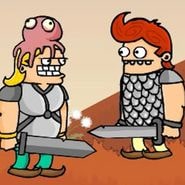



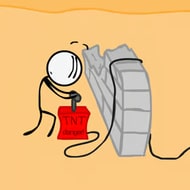
Breaking the Bank is the first game in the Henry Stickmin series, and it sets the tone for everything that follows: Henry stands in a desert with one goal and absolutely no reliable plan, and you get to choose how badly each attempt goes before one of them actually works. The heist is simple. The path to completing it is a tour through creative failure.
| Genre | Point-and-click / choose-your-own-adventure comedy |
| Series | Henry Stickmin (installment 1) |
| Developer | Puffballs United |
| Platform | Browser (PC) |
| Control | Left mouse button only |
Breaking the Bank presents Henry with six approaches to entering the desert bank: tunnel construction, explosives, laser drilling, a wrecking ball, a teleporter, and a disguise. Each method produces a short animated sequence that plays out the consequences of that choice — and most of them end badly in ways that are specifically engineered to be funny. The game is not punishing these choices because it wants you to grind or retry with better reflexes. It is punishing them because watching Henry fail spectacularly at each one is the actual content.
The player who tries to solve Breaking the Bank on the first attempt by picking the most logical option — probably the disguise or the tunnel — will clear the game quickly and miss most of what makes it memorable. The community consensus is that you should try every method before caring about which one succeeds, because the laser drill sequence and the wrecking ball outcome are each worth seeing independently of any completion goal. Sequence hunters, players who want to have seen every animated outcome before finishing, treat Breaking the Bank as a gallery to exhaust rather than a puzzle to solve optimally.
With only six choices and a single left-click control scheme, the game takes most players under ten minutes to complete the first run. Total completion — watching all six outcomes — adds another five to eight minutes depending on how many you have already seen. This makes Breaking the Bank the shortest entry in the Henry Stickmin series by a significant margin, and that brevity is worth knowing if you are coming in after playing one of the later, longer installments first.
What Breaking the Bank established for the series is a specific comedic contract with the player: you are not being asked to be clever, you are being asked to be curious. The animated failure states are where Puffballs United’s humor lands most consistently, and the desert bank setting — isolated, sparse, slightly absurd as a robbery target — gives each failed method a clean stage to play out on without environmental clutter competing for attention.
Players who come from Escaping the Prison or Infiltrating the Airship sometimes find Breaking the Bank underwhelming by comparison, since those later entries have more branching paths, longer sequences, and more choices per stage. That criticism is fair on a structural level. Breaking the Bank is genuinely simpler than what the series became, and it reads more like a proof of concept than a fully realized installment when placed next to Stealing the Diamond or Fleeing the Complex. The community generally frames this as expected for a series opener rather than a flaw, but it is worth knowing before you start.
Because every method produces a different animated outcome, replay in Breaking the Bank is driven entirely by completion rather than improvement. There is no timing to optimize, no resource to manage more efficiently, and no hidden path unlocked by combining choices in a specific sequence. You click a method, you watch what happens, you click the next one.
The one dimension of discovery the game preserves is that the outcomes are not all equally absurd — some land harder than others, and which one surprises you most depends on which order you try them in. Players who start with the teleporter first tend to find the wrecking ball funnier by contrast. Players who exhaust the more grounded methods before touching the teleporter often find it lands as the clearest punchline. The order matters for comedic effect even when it does not matter for completion.
Yes. Only one of Henry’s six methods results in a successful bank entry, and the remaining five each end in a distinct failure state with its own animated sequence. The game does not hide a secret seventh path or reward a specific combination of prior choices — the single success is the same every run, regardless of what order you tried the other methods in.
A single run to the successful ending takes most players under five minutes. Watching all six method outcomes in one session adds roughly five to ten additional minutes. Breaking the Bank is intentionally short — it is the first installment in the Henry Stickmin series and functions as an introduction to the format rather than a full-length entry.
No. Breaking the Bank is self-contained, and the Henry Stickmin series does not carry decisions forward from this entry in a way that changes later installments. Each game in the series is designed to be played independently, and the later entries in the Completing the Mission collection do reference past events through recap screens rather than branching saves.
Breaking the Bank is worth playing exactly as long as it takes to watch all six of Henry’s attempts unfold — which is not very long, and that is fine. The teleporter, the tunnel, and the disguise each do something funny enough to justify the extra clicks, and seeing the full set of failure states gives the single successful outcome a better payoff than reaching it on the first try would. It is a compact, cheerful introduction to Henry Stickmin that does not overstay its welcome.