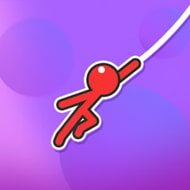
You’re dangling from a single hook thirty feet above a pit, holding a stickman who has no legs to run with and no ground to land on if you time the swing wrong — which is exactly the situation Stickman Hook drops you into for roughly 140 levels in a row, and somehow that’s the entire appeal.
| Genre |
Physics Swinging / Arcade |
| Platform |
Browser (Poki exclusive) |
| Levels |
Around 140 |
| Reception |
Roughly 6.5 million upvotes on Poki |
Three Inputs, No Room for a Fourth
Stickman Hook keeps its control scheme deliberately narrow: tap to attach your rope to the nearest hook, release to launch forward, and use bounce pads when they appear to reposition mid-air. There’s no run button, no double jump outside of what momentum gives you, and no way to correct a bad swing except starting the next one better. That narrowness is the entire design — with only three things to master, the game can throw increasingly precise hook placement at you without ever needing to teach a new mechanic.
The First Twenty Levels Are a Tutorial in Disguise
The opening stretch of Stickman Hook — roughly its first 20 levels — keeps obstacles minimal and hook placement forgiving, which lets new players build a feel for swing arcs and bounce pads without the pressure of tight timing. It doesn’t feel like a tutorial while you’re playing it, since there’s no explicit instruction beyond the first tap, but the level design is clearly paced to teach momentum before it starts demanding it.
Past level 20, that changes fast: bounce platforms multiply, hooks get placed closer to hazards, and the game starts expecting smooth chained swings with hook-release timing that punishes hesitation. The jump in difficulty right around that point is one of the most commonly mentioned adjustments new players have to make.
Reading Momentum Instead of Reading the Level
Stickman Hook’s actual skill ceiling is entirely about momentum management rather than reaction speed. Releasing at the peak of your forward swing sends you the farthest, while releasing too early or too late — especially low in the arc — bleeds speed you won’t get back mid-air. Wider swing arcs build more usable momentum than short, cautious ones, which is counterintuitive the first time a cautious swing leaves you short of the next hook by a few pixels.
Bounce pads complicate that further, since they exist specifically to interrupt a swing’s momentum and redirect it, meaning a player who’s mastered pure hook-swinging still has to relearn timing every time a pad enters a level’s layout.
Skins: The Only Thing Worth Grinding For in Stickman Hook
Stickman Hook offers 23 total skins for the stickman himself, including a set of 9 “classic” skins, 8 of which unlock through normal level progression rather than a separate currency grind. None of it changes how the rope, hooks, or bounce pads behave — it’s purely cosmetic — but it gives long-session players a visible marker of how far they’ve pushed into the level list beyond just the level number itself.
Where New Players Lose Runs
- Releasing too low in the swing arc — kills forward momentum right when a level needs it most.
- Treating bounce pads like normal ground — they redirect momentum instead of just stopping it, and landing on one expecting a dead stop usually ends badly.
- Panicking after level 20’s difficulty jump — the instinct to swing more cautiously actually makes tight hook chains harder, not easier.
Swing Mechanics, Answered Directly
- How many levels does Stickman Hook have? Around 140, split between an early stretch that plays like an unlabeled tutorial and a much harder back half built around chained swings and bounce-pad redirection.
- What’s the best way to build momentum? Swing in wide arcs and release at the peak of your forward motion — releasing low in the arc is the single biggest momentum killer in the game.
- Do skins affect gameplay in Stickman Hook? No, all 23 skins are cosmetic only; the swing physics stay identical no matter which one is equipped.
Stickman Hook never really adds new verbs to its stickman’s toolkit — tap, release, ride a bounce pad, repeat — but the way those three things interact across 140 levels is enough to turn a single hook and a length of rope into a genuine skill ceiling most players don’t hit until they’ve already fallen off it a dozen times.