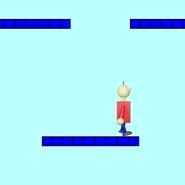
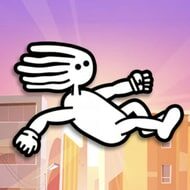
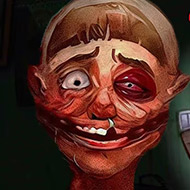
You duck a second before a giant fist slams into the space your head just occupied, and for a moment it looks like you’ve cleared the obstacle clean — then your ragdoll legs clip the edge of the platform anyway and you’re rag-dolling into a pit you’d already forgotten was there. That’s a normal five seconds in Short Life 2, a game built entirely around watching your own stickman fail in increasingly elaborate ways.
| Genre |
Physics Platformer / Ragdoll Obstacle Course |
| Developer |
GameTornado |
| Levels |
20+ |
| Controls |
Arrow keys or A/D, jump, duck |
A Ragdoll With Only Three Moves
Short Life 2 gives its stickman exactly three actions — move left or right, jump, and duck — and builds every one of its 20-plus levels around forcing you to combine them under pressure. Because the character is fully ragdoll-physics based, even a technically correct jump can end badly if momentum carries a limb into a hazard your input didn’t account for, which is where most of the game’s dark comedy comes from.
Each level ramps up more than the last: the traps that killed you in level three look tame by level twelve, when grenades, face-height spikes, and a crushing giant fist all start appearing in the same short stretch of level instead of spaced out politely.
Trial, Error, and Memorizing the Kill Zones
Short Life 2 doesn’t hide its expectation that you’ll die often before clearing a level — the game is paced around trial and error, and the honest strategy the community actually uses is memorizing where a level’s deadliest traps sit rather than reacting to them fresh each run. A grenade that catches you off guard the first time is a grenade you duck under automatically the fifth time, once its timing is memorized.
That memorization loop is also what makes the ragdoll physics forgiving in practice even though it looks chaotic — once you know a jump’s timing cold, the physics behave consistently enough to clear the same gap the same way every attempt.
Stars and Unlocking New Characters
Scattered through the levels are collectible stars, and gathering enough of them unlocks new playable characters beyond the default stickman. None of the characters change the three-action moveset — the appeal is cosmetic and completionist, giving a reason to replay early levels cleanly for stars instead of just rushing to the next checkpoint.
Why Short Life 2’s Later Levels Feel Different
Early Short Life 2 levels tend to isolate a single hazard type long enough for it to register — a run of spikes, then a gap, then a grenade — while later levels stop giving that breathing room, layering a giant fist swing directly over a spike patch so that avoiding one hazard walks you straight into the other. That layering is what separates a level that takes two attempts from one that takes twenty, more than any single trap being individually harder to read.
Answering What New Players Actually Search
Why does my character die from things that don’t look like they touched me? Because Short Life 2 runs on ragdoll physics rather than a fixed hitbox, trailing limbs or momentum can carry part of your body into a hazard even after your main jump technically cleared it — this is the single most common source of confused deaths in early levels.
What are the stars for? Collecting stars scattered through levels unlocks additional playable characters, which don’t change controls or physics but give a completionist goal beyond simply finishing each level once.
Is memorizing levels really necessary, or is it possible to react in real time? Community consensus leans toward memorization — later levels stack multiple hazard types close enough together that reacting cold rather than recalling their placement usually costs a run.
Short Life 2 never pretends its ragdoll stickman is in full control, and that’s precisely the joke it keeps telling for 20-plus levels — you’ll clear the giant fist, the grenade, and the spikes eventually, just not on the first, second, or usually fifth attempt.