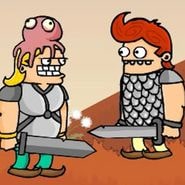
In Rowdy Wrestling, you stun your opponent, grab a folding steel chair off the mat, and either hit them with it or throw them clean over the top rope — and however that plays out, the ragdoll physics guarantee it won’t look like you planned it, even when you did.
| Genre |
Ragdoll Physics Wrestling |
| Developer |
Colin Lane Games AB |
| Released |
Around July 2018 |
| Roster |
55+ wrestlers |
Punches, Kicks, and the Dropkick That Defines Every Match
Rowdy Wrestling’s basic moveset is small on paper — punch, kick, and a jumping dropkick — but the Up + Z dropkick input is the move players lean on constantly, since it covers distance and knocks an opponent into a stunned state faster than trading regular punches. Once an opponent is stunned, the real decision point opens up: grab for a body slam, go for a suplex to throw them across the ring, or head for whatever weapon happens to be lying around.
Ragdoll Physics Make Every Slam Different
Because wrestlers flop and fly with genuine ragdoll physics rather than scripted animations, the same suplex input can send an opponent tumbling in a completely different direction depending on the angle and momentum at the moment of the grab. That unpredictability is treated as a feature rather than a flaw by the community — it’s specifically what turns a technically simple moveset into matches that rarely play out the same way twice.
Steel Chairs and the Over-the-Top-Rope Win
Weapons in Rowdy Wrestling show up randomly during a match, most commonly steel chairs that deal extra damage on a solid hit. The core winning pattern the game is built around is stunning your rival, grabbing whatever weapon is nearest, and sending them flying over the top rope entirely — a win condition that rewards combining the stun-grab-throw sequence over just repeatedly punching an opponent down.
Rowdy Wrestling’s 55-Plus Wrestlers, Each With Their Own Stats
The roster runs past 55 unique wrestlers, and each carries different stats rather than being a reskin, which means matchups shift depending on which two fighters end up in the ring together. Picking a roster wrestler suited to a specific mode — brawling stats for Rumble’s chaos, more technical stats for one-on-one Career matches — is part of the strategic layer sitting underneath the game’s goofy presentation.
Three Modes, Three Different Rhythms
- Solo Career: one-on-one matches where reading a single opponent’s stun windows matters most.
- Rumble: multiple wrestlers in the ring simultaneously, where positioning to avoid being thrown out yourself matters as much as throwing others out.
- Tag Team: shared stamina and setup opportunities between two wrestlers, changing when a stun-grab-throw sequence is worth attempting.
Ring Questions Worth Settling
What’s the fastest way to stun an opponent in Rowdy Wrestling?
The Up + Z jumping dropkick is the move most players default to, since it closes distance and stuns faster and more reliably than trading regular punches and kicks.
Do steel chairs appear in every match?
Weapons like steel chairs appear randomly rather than on a fixed schedule, adding an extra layer of chaos since you can’t plan a match around guaranteed weapon access.
Does every wrestler play the same regardless of who you pick?
No — with over 55 wrestlers each carrying their own stats, matchups change meaningfully depending on which two fighters end up facing off, rather than every roster pick functioning as a cosmetic reskin.
Whatever mode you land in, Rowdy Wrestling keeps coming back to the same loop — stun, grab, and either slam or throw — and it’s the ragdoll physics underneath that loop that keep even a 55-wrestler roster from ever feeling like it’s run out of new ways to end a match.